|
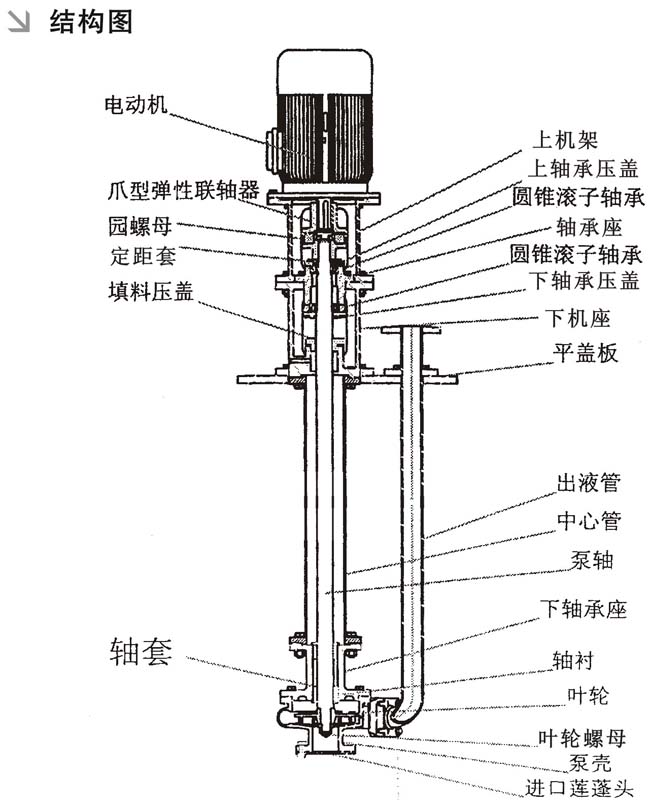
Vertical pump structure improvementThe hydraulic pump is a single-stage vertical cantilever centrifugal pump. The pump body is submerged in the medium, which is suitable for acid material in the suction industry, and can also be used in other chemical processes with viscosity lower than 300cp to deliver corrosive solid and viscous liquids. The temperature of the medium pump under 100 ℃. When a client USES a hydraulic pump, the pump will be broken and the impeller will wear seriously if the actual operation is not more than 10 days. Judging from the damage, the location of the broken shaft is at the impeller nut, while the wear on the impeller ring is the most serious, which is mainly caused by the imbalance of radial force. 1. The reason for the imbalance of radial force is that in the centrifugal pump with spiral pressure chamber, if the pump runs out of the design condition, the radial liquid pressure will be received on the impeller. This is because when the water pump operation at design conditions, the impeller outlet of flow velocity and pressure in liquid flow out of the water chamber of the liquid flow rate, liquid flow into the pressurized water chamber does not produce a slam, pressurized water chamber around the pressure of the liquid is the same, equal to the liquid pressure around the impeller, the impeller does not effect on the radial force; If the pump operates in an undesigned condition (for example, the flow rate is less than the designed condition) The flow rate of the liquid flow in the pressure chamber should also be smaller than that in the design condition, while the flow rate of the liquid flow out of the impeller should be larger than that in the design condition, which can be seen from the exit velocity triangle. In this way, when the liquid flows into the pressurized water chamber, there will be an impact phenomenon, changing the kinetic energy of the liquid into the pressure energy. The pressure of the liquid in the pressurized water chamber keeps getting hit along the way to increase the pressure. Therefore, the pressure of the liquid starts to increase gradually from the tongue of the pressurised water chamber, as shown in figure 1.
(1) if the flow rate of the pump running is greater than that of the design condition, the situation is reversed: the velocity of the liquid flowing out of the impeller is smaller than that of the design condition, while that of the liquid in the pressure water chamber is larger than that of the design condition; The impeller flows out of the slower liquid into the pressurized water chamber to produce impact, which increases the speed and lowers the pressure. Thus, the liquid pressure decreases gradually from the volute tongue, as shown in figure 2. (2) when the traffic flow is less than the design conditions, can see from figure 1, by the impact of the direction of the radial force P should be pointing away from every tongue, and to the spiral case in the direction of the flow in the same direction to turn 90 °, it is easy to prove. In FIG. 1, along the circumference pressure distribution line, ABC is a spiral line in which the rise is proportional to the Angle. At the beginning of the 180 ° from every tongue, do A the same spiral A 'B', put every tongue from 180 ° to 360 ° pressure into two segments, namely with AB exactly the same part and A 'A' B BCB 'section. The radial force caused by part AB is exactly offset by the radial force caused by part A 'B', while the residual pressure of part A 'BCB' is the same. Therefore, the direction of the radial force P should be upward, pointing the direction of 90 ° from every tongue. Similarly, when the flow is greater than the design flow, this part of the radial force P should be pointing to the lower part, which points to 270 ° from every tongue. This is the main reason for the radial force. When the pump flow is less than the design flow, dynamic reaction force on the circumference of a circle if counterclockwise to 90 °, the distribution of the dynamic reaction force R and the shape of the figure 2, the resultant force should be down. Clockwise (90 °, the dynamic reaction force direction, it is point to every tongue. Thus it can be seen that when the pump flow rate is greater than the designed flow rate, the radial force formed by the dynamic reaction force should point in the opposite direction of the tongue. Both P and R are drawn on FIG. 1 and FIG. 2, and the resultant F is the radial force acting on the impeller by the liquid. As you can see: when the pump flow rate is less than the design load, radial force pointing in the direction of less than 90 ° from every tongue; When the water pump flow rate is greater than the design conditions, pointing, contrary to the above, pointing in the direction of less than 270 ° from every tongue. The magnitude of the radial force can be given by A. A. Empirical formula calculation of A schipanov: F = 0.172[1-q /Qd]2 HB2D2, g. B2 is the width of the impeller outlet. 2. Solutions to the imbalance of radial force The structure of the pump under sulphate acid liquid generally adopts the pressure-water chamber structure of single vortex housing and the impeller structure with mouth ring, as shown in FIG. 3. According to the damage situation, the following structural improvements are made: (1) double helix pressure water chamber (the original structure was single helix) was adopted, as shown in figure 4. The double-helix pressurized water chamber mainly USES the symmetrical structure of two vortex shells to balance the radial force. It can be seen from FIG. 1 and FIG. 2 that it can balance the radial force generated when deviating from the working condition. For smaller centrifugal pumps, this will reduce hydraulic efficiency; For larger pumps, experience has shown that the double helix chamber does not reduce the efficiency of the pump. So you can do this. (1) the structure of the impeller is adjusted, that is, the impeller is modified to be sealed with a single end face outside, and the contact area remains unchanged. The original structure and the improved structure are shown in FIG. 5 and FIG. 6. The improved structure prevents the impeller from wearing when the shaft deflection is large. The original structure will wear the impeller greatly when deflection is large, so that the impeller shaft will be broken. The improved situation can avoid this situation, which is of great benefit to the safe operation of the impeller. The improved hydraulic pump has been running safely for more than half a year and is running well. The improvement of these two structures provides a good reference method for future pump design. |